Row scopes
A scope says which rows a permission reaches. Access, Row scopes lists every scope each model offers, how it was made, and how many grants use it:
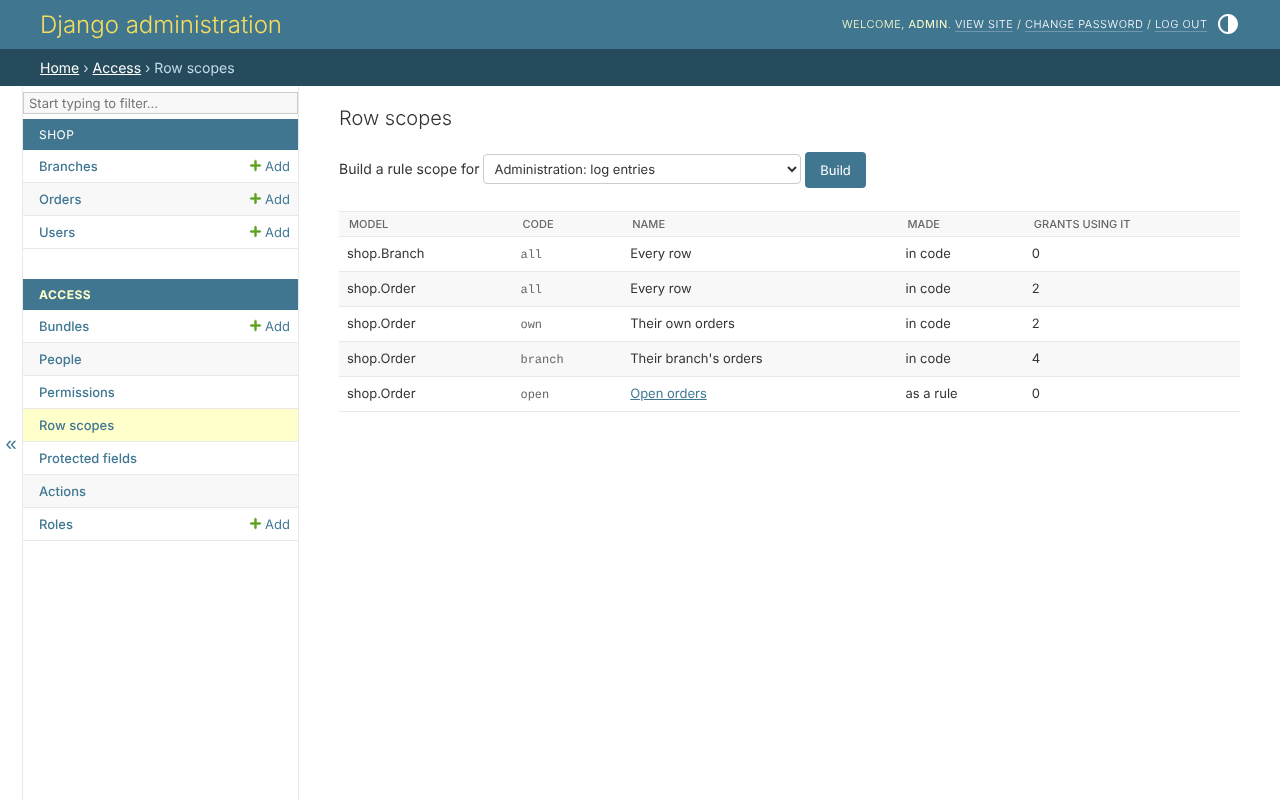
all- every row - is offered for every model.- In code - a
scope_<code>method of the model's queryset, such as Their branch's orders. Changed in the code. - As a rule - built on this page, with no code.
A rule that no longer checks out is marked: it reaches nothing until it is mended.
Building a rule
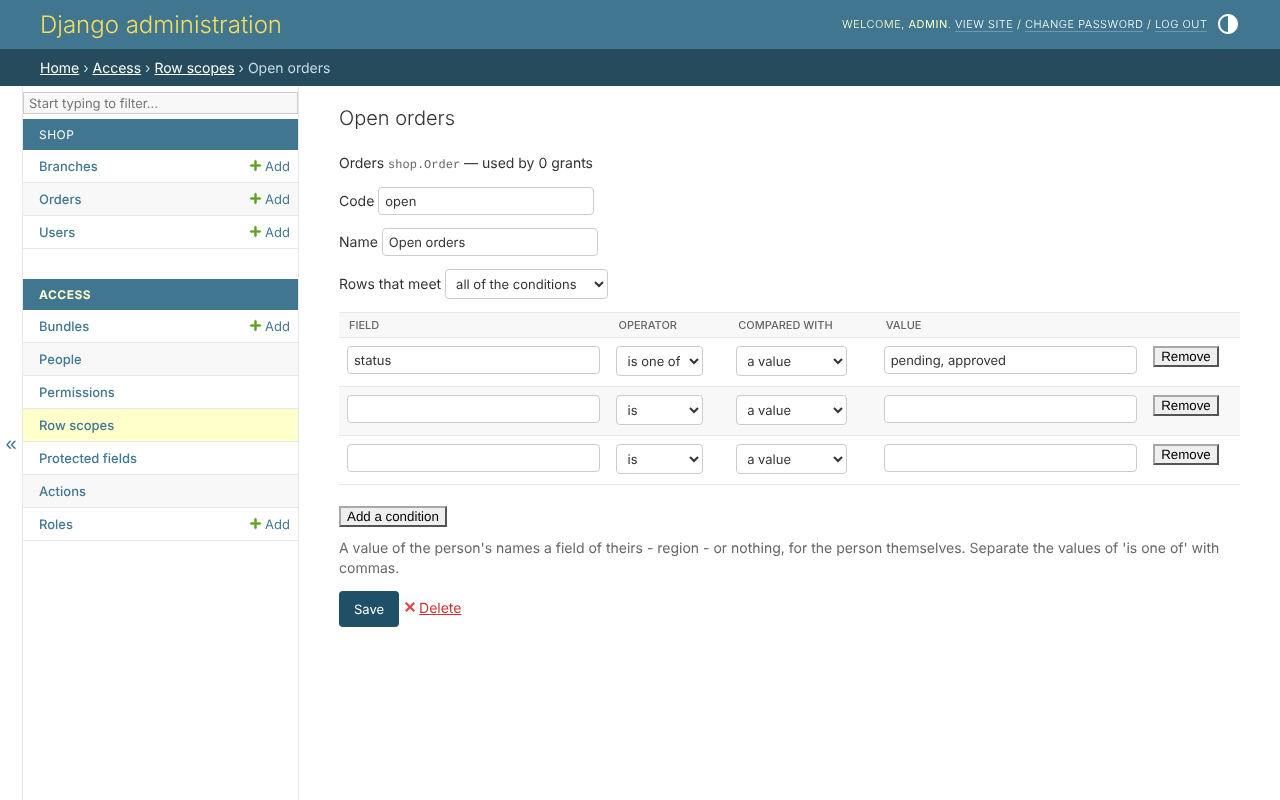
Build a rule scope for, a model, Build. Then:
| part | what it is |
|---|---|
| Code | the scope's name in the code and in the ACCESS file - never all, never a code scope's |
| Name | what the bundle grid shows |
| Rows that meet | all of the conditions, or any of the conditions |
| a condition | a field, an operator, what it is compared with, and the value |
A condition is compared with a value - pending, approved, the values of
is one of separated with commas - or with something of the person's:
the person's with a field of theirs, such as branch, or nothing, for the
person themselves.
The operators are is, is not, is one of, contains, is empty, before, after, at least and at most. Add a condition adds a line; without the page's script, three lines are offered at a time.
When it is saved
Every condition is checked against the model as it is, and each one wrong is named:
- the field must exist, at most
RULE_DEPTHrelations away - three, unless the settings say otherwise; - the operator must suit the field, and a value be one it can hold - one of its choices, when it has them;
- no condition reads a protected field, or the password - a filter on the price would tell whoever holds the rule what the price is;
- a condition reaching another model -
customer__email- reads that model, so whoever writes it must be allowed to view all of it.
Once saved, the rule is offered beside every permission of its model, in the bundle grid and on a person's page.
What is refused
- changing the rows of a rule your own grants are in - it would widen your own access; renaming it is no change;
- changing the rows of a rule without every permission granted in it, on every row;
- deleting a rule still chosen in a grant - move its grants first.