Actions
Beyond view, create, edit and delete, a model has the actions its project gives it. Access, Actions shows both kinds:
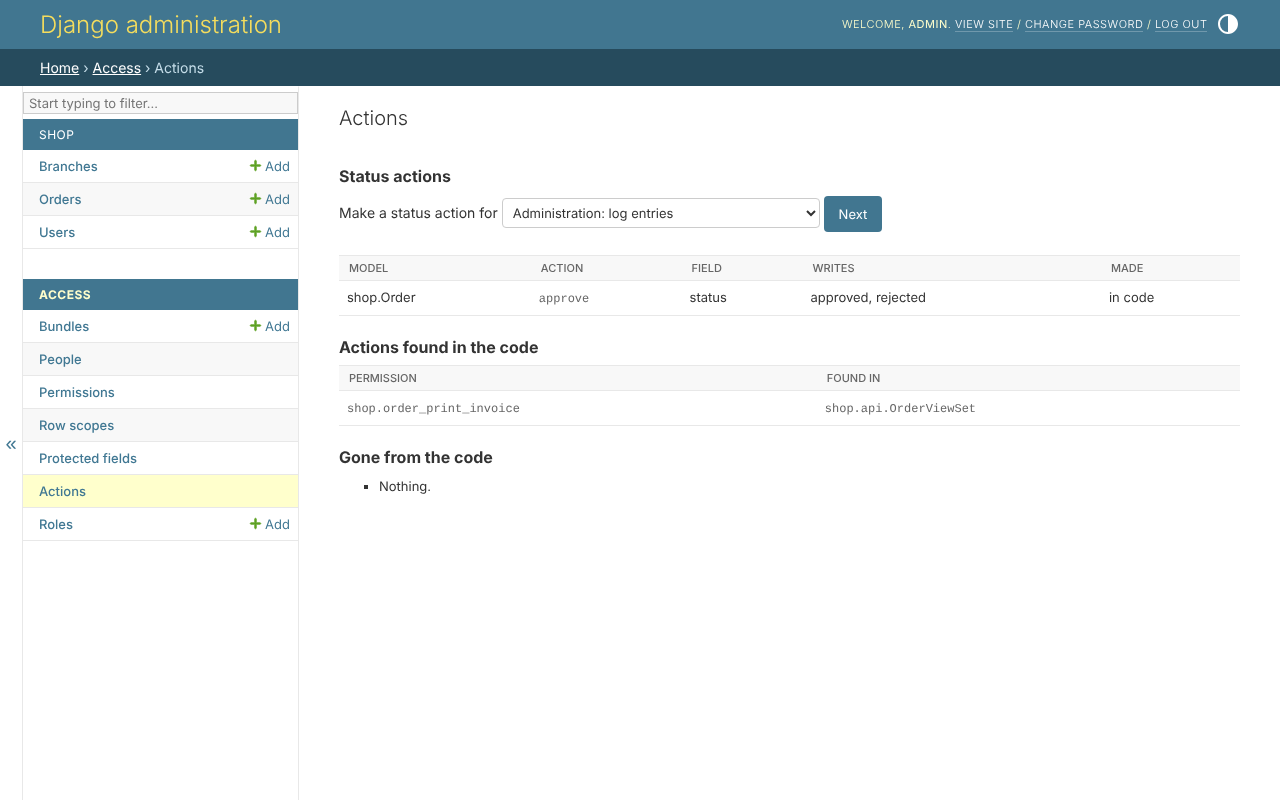
Status actions
A status action is an action that writes values: only whoever may approve sets an order to approved or rejected. It needs no code.
Make a status action for, a model, Next; then the field it writes - a field with choices, or yes or no - and then:
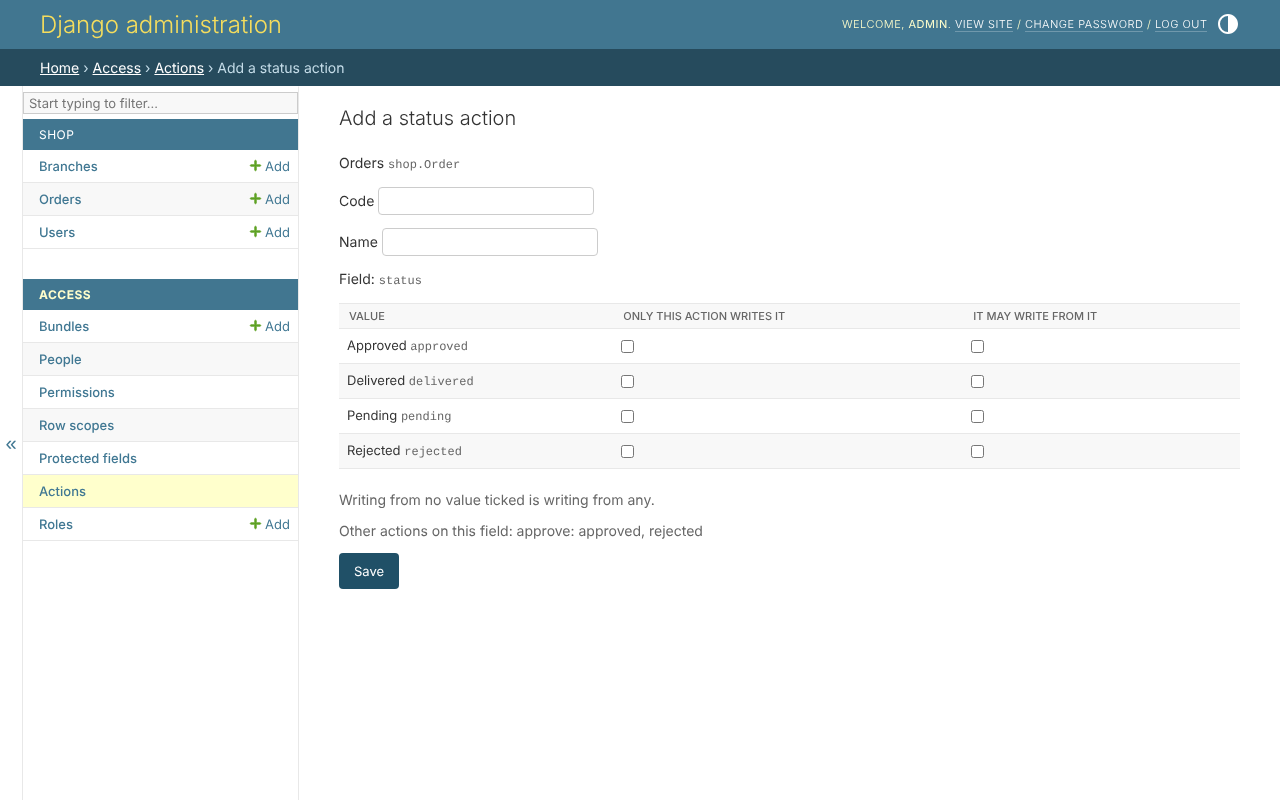
| column | what a tick says |
|---|---|
| Only this action writes it | whoever lacks the action cannot write this value |
| It may write from it | the action writes only from these values; none ticked is from any |
Saving it makes its permission - shop.order_<code>, for the shop's
orders - held by nobody until it is given. A value no action claims is
written by whoever may edit the row. Other actions on this field lists what other actions on the same
field already claim.
A status action declared in code - in build_permissions, or the ACCESS
file - is shown in code, read only.
Actions found in the code
An action that does something new - prints an invoice, exports a sheet - is
code, but its permission is not: migrate finds it and makes it.
| in the code | becomes |
|---|---|
a DRF @action on a viewset asking a policy |
<codename>_<action> |
policy_action = '...' on a view |
the same |
@policy_required(policy, '...') on a function view |
the same |
an admin action with no permissions= |
the same |
The page lists each, and where it was found. Gone from the code lists the permissions nothing checks any more - an action removed, or one made by hand - to be deleted, or explained.
What is refused
- a field with no choices that is not yes or no, a value not one of the field's, a code the model has already;
- releasing a value, or deleting the action, without holding it on every row - the value would be written by whoever may edit;
- letting an action write from more values - it gives whoever holds it more.
That is the superuser's, or the
ACCESSfile's.