4. Row scopes in code
A scope says which rows a permission reaches. A model offers its scopes on its queryset:
"""Which orders a grant reaches: the scopes the code offers beside the admin site's."""

from types import MappingProxyType

from django.db.models import Q
from django.utils.translation import gettext_lazy as _

from clearance.querysets import ScopedQuerySet


class OrderQuerySet(ScopedQuerySet):
    scopes = MappingProxyType(
        {
            'own': _('Their own orders'),
            'branch': _("Their branch's orders"),
        }
    )

    def scope_own(self, user):
        return Q(customer=user)

    def scope_branch(self, user):
        return Q(branch=getattr(user, 'branch_id', None))
Each scope is a name, a label the admin site shows, and a method that
answers a Q for the person. all is always offered beside them. The order
uses the queryset as its manager - objects = OrderQuerySet.as_manager(),
in step 2.
Asking for rows
Order.objects.visible_to(user)            # the orders they may view
Order.objects.visible_to(user, 'edit')    # the orders they may edit
For the shop's people:
| person | holds | visible_to(person) |
|---|---|---|
north_manager |
order_view in branch |
the desk lamp and the office chair - North's |
accountant |
order_view in all |
all four |
alice |
order_view in own |
the desk lamp and the bookshelf - hers |
| somebody given nothing | nothing | nothing |
A person's grants are read once per request, in a fixed number of queries, however many lists a page shows.
Every door asks it
The admin site, Django's views and the API all ask the same visible_to.
Signed in as north_manager, the admin site's list of orders holds North's
and nothing else - and no price, which is step 6:
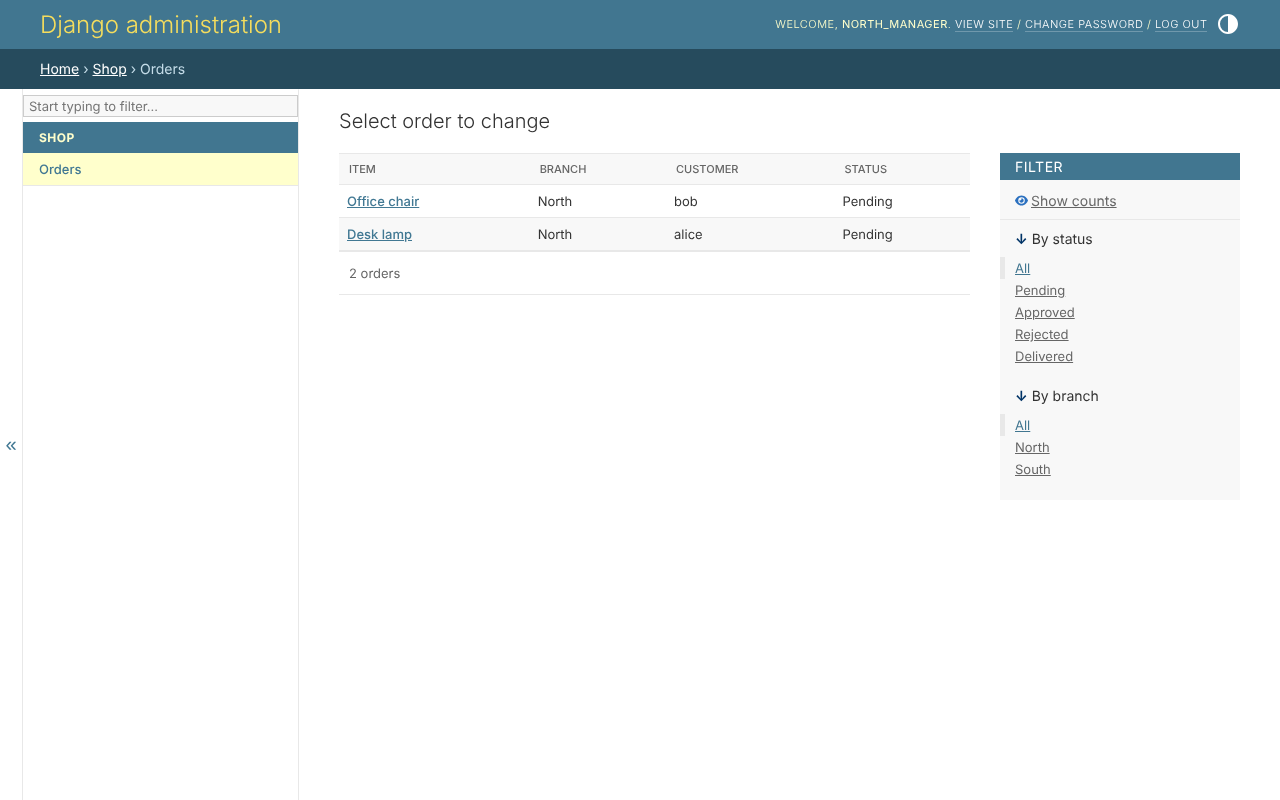
An order of another branch is not refused to them: it does not exist for them, the same 404 as an order that was never placed.
Writing rows
A scope holds for what is written too: an order created outside the scope
create was given in, or edited out of the rows the person reaches, is
refused and the write undone.